TL;DR

Turn your wind-down time into listening time
- Thousands of audiobooks, podcasts and originals
- Listen on your phone, tablet or Echo — also offline
- Cancel anytime
A Being Patient report used a personal DEXA scan to examine the possible connection between visceral fat and long-term health. Research cited in the report links visceral fat with high blood pressure, while separate evidence links untreated hypertension with higher Alzheimer’s risk; the findings do not establish that belly fat itself predicts brain health or that reducing it prevents dementia.
A personal DEXA scan has prompted Being Patient founder Deborah Kan to examine how visceral fat may relate to brain health, but the research she cites does not show that a belly-fat measurement can diagnose or predict dementia. The evidence instead points to a possible indirect connection: visceral fat has been associated with high blood pressure, and a separate 2024 study linked untreated hypertension to increased Alzheimer’s risk.
Kan writes that she paid about $50 for a DEXA scan, which took seven minutes and provided an estimate of her body composition. Her report put her visceral fat at 0.41 pounds and placed her in the lowest-fat group among 27,000 people in her age group. She cautioned that the comparison group may be unusually health-conscious because people who pay for scans may differ from the wider population.
A DEXA scan estimates the amount of visceral fat; it is not an MRI showing precisely where fat sits around organs. Kan’s individual result cannot establish why she has that measurement or what it means for her future health. She also said she could not tell whether her running had contributed to the result.
The report cites a University of Texas Southwestern Medical Center study that followed 903 people in Dallas for seven years. Participants had normal blood pressure at the start, and researchers used imaging to map fat distribution. About one quarter developed hypertension. Body weight was associated with who developed high blood pressure, but after researchers accounted for fat location, visceral fat was the fat type still associated with the condition, according to the report.
Blood Pressure Links Fat to Brain Risk
The potential significance is not that a scan can reveal whether someone will develop dementia. It is that blood pressure may be a more actionable connection between body fat and brain health. High blood pressure can damage blood vessels, including those supplying the brain, and often has no obvious symptoms.
The report also cites a 2024 study of more than 31,000 older adults across 14 countries. Untreated high blood pressure was associated with a 42 percent higher chance of developing Alzheimer’s disease. The report says that extra risk was not seen among people whose hypertension was controlled. This finding concerns blood pressure, not a direct effect of visceral fat, and an association does not prove that hypertension caused each case.
For readers, the practical distinction matters: a commercial body-composition estimate is not a brain-health test. Kan argues that her scan’s useful result was directing her attention to regular blood-pressure checks, a measurement that may identify a risk factor even when a person feels well.
personal DEXA scan for body composition
As an affiliate, we earn on qualifying purchases.
As an affiliate, we earn on qualifying purchases.
From Fat Distribution to Hypertension
Visceral fat is fat stored deep in the abdomen around internal organs, unlike fat just under the skin. The Being Patient report says its scan report associated higher visceral-fat levels with heart disease, type 2 diabetes and some cancers. Those general risk statements do not establish that every person with visceral fat will develop those conditions.
The Dallas study adds to research on the location of body fat, rather than weight alone. The report also mentions studies suggesting fat around the kidneys could affect hypertension, but says more research is needed to understand that relationship. Taken together, the material describes a possible pathway for further study, not a settled explanation linking abdominal fat directly to Alzheimer’s disease.
“The most useful thing my $50 scan did was point me to a new measurement to monitor my health.”
— Deborah Kan, founder and CEO of Being Patient
As an affiliate, we earn on qualifying purchases.
What Fat Scans Cannot Establish
The cited evidence does not show that a particular visceral-fat score predicts an individual’s Alzheimer’s risk, nor that lowering visceral fat prevents dementia. The Dallas study examined the development of high blood pressure, while the 2024 research examined hypertension and Alzheimer’s risk; these are distinct findings, not proof of a complete causal chain.
It is also unclear how well the scan’s comparison group represents the general population, whether Kan’s running affected her result, and how accurately a consumer-facing scan or home scale estimates visceral fat for any one person. The report does not provide enough detail about the studies’ methods to assess all limitations or to establish what level of visceral fat should be a target.
blood pressure monitor for hypertension
As an affiliate, we earn on qualifying purchases.
As an affiliate, we earn on qualifying purchases.
Blood Pressure Is the Next Check
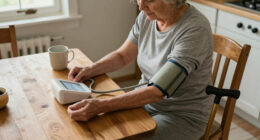
Kan says she plans to check her blood pressure a few times each week with a cuff and keep it in the normal range, which she identifies as below 120 over 80. That is her personal plan and the advice she attributes to Chin; readers should consult a qualified health professional about interpreting measurements and making health decisions.
The research questions remain open: further studies are needed to clarify how visceral and kidney-area fat relate to hypertension, and whether changes in fat distribution affect later brain outcomes. Until then, the report’s evidence supports treating a DEXA result as one body-composition estimate—not as a diagnosis or a stand-alone forecast of cognitive health.
brain health supplements for memory
As an affiliate, we earn on qualifying purchases.
As an affiliate, we earn on qualifying purchases.
Key Questions
No conclusion like that is supported by the research described in the report. It discusses associations between visceral fat and high blood pressure, and between untreated hypertension and Alzheimer’s risk, but does not show that a fat measurement predicts an individual’s dementia outcome.
What did the DEXA scan measure?
Kan’s scan estimated body composition, including visceral fat, and reported a value of 0.41 pounds. The report distinguishes DEXA from MRI: DEXA estimates the amount, while MRI can show where visceral fat is located.
What did the Dallas study find?
In a seven-year study of 903 people who began with normal blood pressure, about one quarter developed hypertension. According to the report, visceral fat remained associated with developing high blood pressure after researchers accounted for where fat was carried.
What is the more direct health measure discussed in the report?
Blood pressure is the report’s practical focus because hypertension can have no symptoms and has been linked in separate research to brain-vessel damage and Alzheimer’s risk. A healthcare professional can advise how to measure and interpret it.
Source: rss
Columbus Day / Indigenous Peoples' Day Picks
long weekend sales
As an affiliate, we earn on qualifying purchases.
![ADHD, Autism Or Complex Trauma? [Pdf]](https://ourmindandbody.com/wp-content/uploads/2026/10/adhd-autism-or-complex-trauma-pdf-featured-560x300.jpg)