This guide walks you through building a working stress relief toolkit: a small set of techniques and physical tools you have personally tested and can reliably use to calm your body and mind within minutes. You will finish with a written routine you can run daily, plus a short list of go-to tools for acute stressful moments. This guide is for anyone who feels stressed and wants a practical, repeatable system rather than vague advice to “relax more.” No prior experience with meditation, breathing exercises, or wellness practices is required. Setup takes one to two hours; using the toolkit takes five to ten minutes a day.

Give the gift of listening to someone who needs a break
- Choose a 1-, 3-, 6- or 12-month membership
- They pick the audiobooks they love
- Easy to send by email

MindSculpt Fidget Putty Set with 52 Guided Calming Exercise Cards
- ✔ ASIN: B0GHBZ7621
- ✔ Includes: 2 silicone putty tubs, 52 mindfulness cards, premium storage box
- ✔ Putty weight per tub: 3 oz

Reflect Orb Smart Biofeedback Device for Stress Relief, Mindfulness & Anxiety
- ✔ ASIN: B0C6V2KDBR
- ✔ Tracking: Real-time heart rate and skin conductance
- ✔ Feedback method: Changing light patterns

InterBreath Guided Breathing Device – 4 Modes for Stress Relief, Mindfulness, Sleep & Focus
- ✔ ASIN: B0H1NVJ5D3
- ✔ Color: Purple
- ✔ Breathing modes: 4 (4-6 Basic, 4-4-6 Advanced, 4-7-8 Deep, 2-4 Quick Adjustment)
Difficulty: Beginner | Time: 1-2 hours to set up; 5-10 minutes daily to use
What You’ll Need
Tools & Materials:
- A timer or phone with a timer function
- Paper and pen, or a notes app
- A quiet space where you can sit undisturbed for 10 minutes
- Optional physical items: earplugs or headphones, a weighted or regular blanket, a heat pack, a stress ball or putty, essential oil or scented lotion, comfortable clothing
Knowledge:
- Ability to sit comfortably and breathe normally
- Willingness to test several techniques and rate them honestly
This guide supports everyday stress management. If you experience panic attacks, severe anxiety, chest pain, or symptoms that interfere with work, sleep, or relationships, consult a doctor or licensed mental health professional before relying on self-directed techniques alone.
MindSculpt Fidget Putty Set with 52 Guided Calming Exercise Cards
The MindSculpt Fidget Putty Set stands out as the most complete stress relief package of the three — and the simplest. Where the Reflect Orb asks you to interpret light patterns and the InterBreath requires learning a pulse rhythm, this set gives you two tubs of never-drying silicone putty plus 52 guided exercise cards that blend somatic, visualization, and creative prompts. That combination of tactile release and structured guidance is rare in this price territory, and it means the set works whether you have thirty seconds or thirty minutes.Two textures — super soft and medium — let you match putty resistance to your stress level, which is a subtle but meaningful advantage over single-texture fidgets. The cards also make this the only option here that works equally well as a group or family activity, suitable for kids 7 and up in classrooms or at home; the two smart devices are strictly solo tools. Compared with the Reflect Orb, you obviously lose all physiological feedback — there is no data proving you are calmer. But you also lose the friction: no app, no charging, no membership cliff after year one.The honest tradeoff is hygiene and feel. The putty has a slightly sticky texture that some users will find off-putting, and MindSculpt asks you to wash hands before and after each use, which adds a small ritual to what should be an impulsive stress reliever. Still, for pure accessibility, durability, and breadth of use, this is the pick we would point most buyers toward first.
Pros:
- Silicone putty never dries out, so the set stays usable indefinitely
- 52 guided cards add real structure to mindfulness and somatic practice
- Safe, ASTM-compliant, non-toxic material suitable for kids 7 and up
- Works solo, in groups, at home, in classrooms, or at the office with no setup at all
Cons:
- Slightly sticky feel may bother some users
- Requires hand washing before and after use
- No measurable feedback on whether your stress is actually reducing
Best for: Families, students, and office workers who want a screen-free, low-cost stress tool that works for both quick fidgeting breaks and structured mindfulness practice.
Not ideal for: Data-driven users who want measurable proof of reduced stress, or anyone sensitive to tacky textures who won’t maintain the hand-washing routine.
Bottom line: The most versatile and lowest-friction stress relief tool in this lineup — our default recommendation unless you specifically want biometric data.
“The most versatile and lowest-friction stress relief tool in this lineup — our default recommendation unless you specifically want biometric data.”
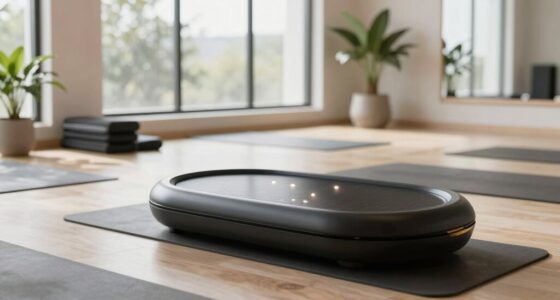
Reflect Orb Smart Biofeedback Device for Stress Relief, Mindfulness & Anxiety
The Reflect Orb is the most scientifically ambitious tool in this roundup. Instead of guessing whether you are relaxed, it tracks heart rate and skin conductance in real time and translates your physiological state into shifting light patterns — you slow your breathing until the light tells you that you have actually calmed down. For people who find guided breathing abstract or frustrating, that closed feedback loop is genuinely different from anything the MindSculpt set or the InterBreath offers.Compared with the InterBreath, the Orb takes the opposite approach to guidance: visual and data-driven rather than tactile. That makes it better suited to home practice, evening wind-downs, and people who like reviewing session insights after the fact — but worse for a shared office, since you need to watch the light rather than just feel a pulse on your wrist. Once set up, it operates independently of your phone, and the up to two weeks of battery life per charge means it is not another daily-charging gadget.The main caveat is cost structure rather than function. The box includes one year of premium app access, after which guided content sits behind a paid membership — though crucially, the core light biofeedback keeps working without renewal. The initial smartphone setup is also unavoidable. If you want the closest thing to a clinical-grade relaxation experience at home and accept a subscription-shaped tradeoff, this is the premium pick that earns its place.
Pros:
- Real-time biofeedback using heart rate and skin conductance — not guesswork
- Works independently of your phone after initial setup
- Up to 2 weeks of battery life per charge
- Core light biofeedback continues without a paid membership renewal
Cons:
- Premium app content requires a paid membership after the first year
- Requires initial smartphone setup before first use
- Light-based guidance is conspicuous and not ideal for shared workspaces
Best for: Analytically minded users who want measurable, real-time evidence that their stress is dropping, and who practice relaxation mostly at home.
Not ideal for: Budget-conscious buyers who dislike subscription models, or anyone wanting a discreet tool for public or office settings.
Bottom line: The only option here that proves relaxation is happening — a premium, data-backed choice for users who trust numbers more than feelings.
“The only option here that proves relaxation is happening — a premium, data-backed choice for users who trust numbers more than feelings.”
InterBreath Guided Breathing Device – 4 Modes for Stress Relief, Mindfulness, Sleep & Focus
The InterBreath solves the problem the other two cannot: discreet stress relief in public. This lightweight wrist wearable guides your breathing through gentle tactile pulses — a long pulse for inhale, a short pulse for the hold, and a quiet pause for the exhale — so nobody around you knows you are mid-meditation. Compared with the Reflect Orb, which demands your visual attention, the InterBreath frees your eyes for the meeting, lecture, or commute happening around you.Its four breathing modes cover a genuinely useful range: 4-6 Basic for everyday calming, 4-4-6 Advanced, the well-known 4-7-8 pattern for deep relaxation and sleep, and a 2-4 Quick Adjustment mode for fast resets between stressful moments. That variety gives it more scenario flexibility than a single-technique tool, and features like automatic session end and an indicator light that shuts off after mode selection show thoughtful attention to the distraction-free experience stressed users actually need.The tradeoff is the learning curve. You must internalize the pulse rhythm before sessions feel intuitive, and if you strongly prefer voice-guided or visual breathing apps, the purely tactile approach may never click. It also offers no feedback on your body’s response, unlike the Orb. But with one-button operation and wireless charging, this is the easiest tool here to actually keep using daily — which, for stress relief, is most of the battle.
Pros:
- Tactile pulse guidance eliminates counting, screens, and sounds entirely
- Four modes span quick resets, focus, everyday calm, and sleep preparation
- Silent, discreet design works in offices, classrooms, and public spaces
- Wireless charging and one-button operation keep daily use effortless
Cons:
- Learning the pulse rhythm takes a few sessions before it feels intuitive
- Not suited to users who prefer visual or audio-guided exercises
- No physiological feedback on your actual stress response
Best for: Commuters, office workers, students, and travelers who need silent, screen-free breathing guidance that fits into a busy day.
Not ideal for: Users who want audio or visual guidance, biometric feedback, or who are unwilling to spend a few sessions learning the pulse rhythm.
Bottom line: The best stress relief tool for real life in motion — the only one here you can genuinely use mid-meeting without anyone noticing.
“The best stress relief tool for real life in motion — the only one here you can genuinely use mid-meeting without anyone noticing.”
As an Amazon Associate we earn from qualifying purchases.
Before You Start
Understand one thing before you begin: relaxation is a physical skill, not a mood you can force. Techniques work by activating your body’s natural calming response — slower breathing, lowered heart rate, released muscle tension. Some techniques will work well for you and others will not. That is normal and expected. Your job in this guide is to test each one and keep only what works. Do not judge any technique before trying it at least twice, and do not practice a new technique for the first time during a highly stressful moment — test everything while you are calm.
Step-by-Step Instructions
Step 1: Set up a distraction-free practice space and baseline measurement
Choose a room or corner where you can sit undisturbed for ten minutes. Silence your phone, or set it to do-not-disturb with only the timer active. Sit in a chair with your feet flat on the floor, or sit cross-legged on a cushion — whichever is comfortable for ten minutes. Then take a baseline reading: rate your current stress level from 1 (completely calm) to 10 (extremely stressed) and write it down. Also note your physical state in one sentence — for example, “tight shoulders, shallow breathing, restless legs.” You will compare against this baseline after every technique you test.
Tip: Keep the room at a comfortable temperature and dim harsh lighting. Physical discomfort during testing will skew your ratings.
Check: You have a written stress rating between 1 and 10 and a one-sentence physical description, and you can sit in your space without interruption.
Step 2: Test slow paced breathing
Set your timer for five minutes. Breathe in through your nose for a count of four, then out through your nose or pursed lips for a count of six. Let the exhale be longer than the inhale — this is what triggers the calming response. Keep the breath quiet and gentle; you should not hear yourself breathing loudly. When your mind wanders, which it will, simply return to counting. When the timer ends, write down a new stress rating from 1 to 10 next to your baseline.
Tip: If a four-in, six-out count feels strained, use three-in, five-out. The ratio matters more than the exact numbers. Never hold your breath or force air — this should feel easy.
Check: Your new stress rating is at least one point lower than your baseline, or you notice slower, deeper breathing than when you started.
Step 3: Test progressive muscle relaxation
Set your timer for eight minutes. Starting with your feet, tense each muscle group firmly but not painfully for five seconds, then release suddenly and notice the relaxation for ten seconds before moving on. Work upward: feet, calves, thighs, glutes, abdomen, hands, arms, shoulders, and face. Scrunch your face tightly on the last group, then release everything and sit still for thirty seconds. Write down a new stress rating.
Tip: Skip any group where you have an injury, pain, or a medical condition like high blood pressure that makes tensing inadvisable — just focus on relaxing that area instead.
Check: Your limbs feel heavier or looser than before, and your written stress rating has dropped.
Step 4: Test a grounding exercise for acute stress
Practice the 5-4-3-2-1 technique, which works during sudden stressful moments. Sit still and name, silently or aloud: five things you can see, four things you can physically feel, three things you can hear, two things you can smell, and one thing you can taste. Move slowly and actually look at, touch, and listen for each item rather than rushing through the list. This takes two to three minutes. Write down a stress rating afterward.
Tip: This technique is your portable tool — it works in meetings, traffic, or queues with no equipment. Practice it twice in your quiet space so it is automatic when you actually need it.
Check: You complete the full 5-4-3-2-1 sequence without losing count, and your racing thoughts feel slower or more ordered.
Step 5: Test a sensory or physical tool
Choose one physical item from your prerequisites — a weighted blanket, heat pack, stress ball, or a scent. Use it for five minutes while sitting quietly: squeeze the ball in rhythm with slow breathing, rest the heat pack on your shoulders, or smell the scent with eyes closed. The goal is to find at least one physical object that reliably shifts how your body feels. Write down a stress rating after testing.
Tip: Scent works best when reserved for relaxation only — if you use the same scent all day, your brain stops associating it with calming down.
Check: At least one physical tool produces a noticeable drop in your stress rating or a clear physical sensation of comfort.
Step 6: Test gentle movement
Set your timer for five minutes and perform slow, simple movement: shoulder rolls backward ten times, slow neck tilts side to side, standing forward fold for thirty seconds, and a slow walk around your space at half your normal speed. Move only within pain-free range. Notice whether the movement changes your breathing or muscle tension. Write down a stress rating afterward.
Tip: If you have any injury, back problems, or a medical condition, keep the range small and stop anything that causes pain. Gentle is the entire point.
Check: Your body feels looser and your breathing is deeper than before you started.
Step 7: Select your toolkit and write your daily routine
Review your written ratings and pick the two techniques that dropped your stress score the most, plus one physical tool. Write your daily routine on paper or in your notes app: which technique, where, and at what time of day. Attach it to an existing habit — for example, “five minutes of paced breathing immediately after lunch” or “muscle relaxation right before bed.” Then write your acute plan: which technique you will use during sudden stress, which for most people is the 5-4-3-2-1 grounding exercise plus one physical tool.
Tip: Choose a specific time tied to a habit you never skip. “Whenever I have time” reliably becomes never.
Check: You have a written daily routine naming one technique, one trigger time, and one place, plus a separate written plan for acute stress.
Step 8: Run the routine daily for one week and adjust
Practice your daily routine once per day for seven days. After each session, jot a one-line note: your stress rating before and after. At the end of the week, review the notes. If a technique stopped working or a time slot proved unrealistic, swap in your third-ranked technique or move the routine to a better time. Adjust the system — the goal is a toolkit that fits your actual life, not a perfect scorecard.
Tip: Expect some days to feel like nothing happened. Relaxation response strengthens with repetition, and a “no effect” day still counts as practice.
Check: You complete at least five of seven days, and your notes show a stress rating drop on most sessions.
Common Mistakes to Avoid
- Testing techniques for the first time during a stressful moment. — Practice every technique while calm, at least twice, before relying on it during real stress. Skills tested only in calm conditions become reliable under pressure; untested ones fall apart.
- Trying to force relaxation and getting frustrated when it does not work instantly. — Judge techniques by small shifts — a one-point drop on your stress scale counts. Relaxation is trained gradually, like fitness, not switched on.
- Forcing the breath — deep gulping air or holding the breath. — Keep breathing quiet and gentle with a longer exhale than inhale. If you feel lightheaded, stop, breathe normally for a minute, and use smaller counts.
- Building a routine around an unrealistic time slot like “first thing when I wake up.” — Anchor the routine to a habit you already do without fail, and have a backup slot. If you miss a day, resume the next day without restarting the week.
Troubleshooting
Problem: Racing thoughts interrupt every breathing or relaxation attempt.
Solution: Do not try to empty your mind — that is not the goal. Treat thoughts like passing cars: notice them and return to the count or the muscle group. If thoughts keep dominating, switch to the 5-4-3-2-1 grounding exercise, which occupies the mind with a concrete task.
Problem: You feel more anxious, not less, when you slow down and sit quietly.
Solution: Shorten sessions to two minutes, keep your eyes open and softly focused on a fixed point, and add gentle movement before sitting. If quiet stillness consistently increases distress, lean on the movement and grounding techniques instead, and consider speaking with a mental health professional.
Problem: No technique seems to move your stress rating.
Solution: Check three things first: are you practicing long enough (five minutes minimum), often enough (daily for a week), and while calm rather than mid-crisis? If all three are true and nothing shifts your rating after two weeks, physical factors like chronic sleep deprivation, caffeine load, or underlying anxiety may be dominant — address those and consult a professional.
Problem: Muscle tensing causes discomfort or cramping.
Solution: Reduce the tension to roughly 50 percent of maximum effort and hold for only three seconds. Skip injured or painful areas entirely and simply direct your attention to relaxing them without tensing first.
What Success Looks Like
You have succeeded when you can point to three concrete things: a written daily routine you have followed at least five days in a row, a written acute-stress plan using a technique you have practiced while calm, and session notes showing your stress rating drops by at least one point on most days. Physically, success looks like recognizing tension in your body earlier, recovering from stressful moments faster, and having a default action — rather than nothing — when stress spikes. The toolkit does not need to eliminate stress; it needs to give you a reliable way to reduce it on demand.
Next Steps
After your first successful week, expand gradually. Add a second daily session at a different time of day — many people keep a morning routine and a pre-sleep routine. Re-test the techniques you ranked lower in a month, since preferences often shift with practice. Track your baseline stress weekly to see longer-term trends. If your stress ratings stay high (7 or above) for several weeks despite consistent practice, or if stress is affecting sleep, appetite, work, or relationships, book an appointment with a doctor or licensed therapist — self-directed tools work best alongside professional support, not as a replacement for it. Review and update your toolkit every few months, retiring what has stopped working and adding one new technique at a time.
Frequently Asked Questions
How long until relaxation techniques actually work?
Most people feel a measurable drop in stress ratings within the first one or two sessions of paced breathing or muscle relaxation, because these directly affect the nervous system. Deeper benefits — falling asleep faster, recovering from stress more quickly — typically build over two to four weeks of daily practice.
How many techniques should I keep in my toolkit?
Two or three for daily and acute use is ideal. A larger toolkit sounds better but usually means none of the techniques get practiced enough to become reliable. Keep one primary daily practice, one acute-stress technique, and one physical tool, with one backup technique you have tested.
What if I only have two minutes?
Two minutes is enough for the 5-4-3-2-1 grounding exercise or ten rounds of paced breathing at four counts in, six counts out. Short sessions count fully — consistency matters far more than duration.
Do I need to buy anything?
No. The most effective techniques — paced breathing, muscle relaxation, and grounding — require nothing but a place to sit. Physical tools like weighted blankets or heat packs add comfort but are optional extras, not prerequisites.
Can these techniques replace therapy or medication?
No. These tools manage everyday stress and complement professional treatment. If you have a diagnosed anxiety condition, depression, or persistent high stress, use this toolkit alongside — never instead of — care from a doctor or licensed mental health professional.