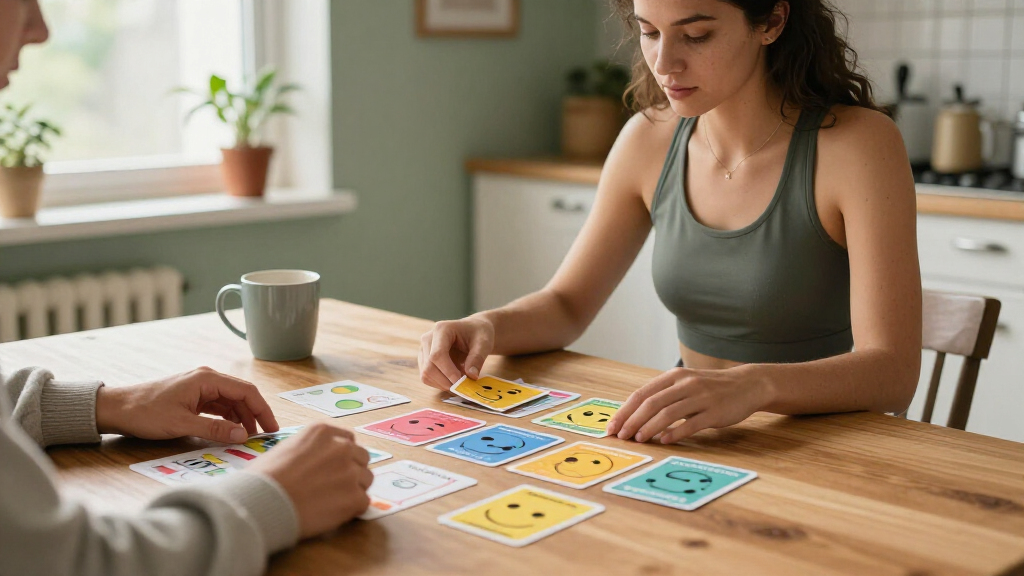
Adult emotion regulation card games range from structured skills practice to open-ended prompts for reflection, mindfulness, and conversation. I name DBT Coping Skills Flash Cards my best overall pick for its direct focus on emotional regulation and mindfulness, while FeelWise stands out for its broad mix of emotion and technique cards and the Neurodivergent Support Cards for tailored reflection. The main tradeoff is between step-by-step tools and flexible prompts, with format, reading comfort, and whether you plan to use a deck alone or with others also shaping the choice. A deck can support practice, but it is not a substitute for professional care when that is needed. Read on for the full comparison, selection criteria, and advice on choosing the right style for you.

Turn your wind-down time into listening time
- Thousands of audiobooks, podcasts and originals
- Listen on your phone, tablet or Echo — also offline
- Cancel anytime
Key Takeaways
- DBT Coping Skills Flash Cards lead for shoppers who want an explicit connection to emotional regulation and mindfulness skills rather than a general reflection deck.
- FeelWise pairs 156 emotion cards with 37 mindfulness technique cards, making it the most varied choice for people who want to name feelings and select a practice.
- Neurodivergent Support Cards have the clearest audience-specific focus, while the other decks are more broadly framed for adults.
- Art Therapy Cards offer a creative route through drawing and reflection, but may suit people who enjoy visual exercises better than those seeking direct instructions.
- The lineup spans individual reflection, skill prompts, and conversation games; the right format depends as much on how and with whom you will use the cards as on the deck’s topic.
| Coping Skills Cards for Anxiety and Stress Relief |  | Best for Quick Sensory Resets | Brand: Deyl cavier | Card count: 10 | Coping skills: 20+ | VIEW LATEST PRICE | See Our Full Breakdown |
| Emotional Intelligence Mindset Cards with Wooden Display Stand |  | Best for Shared Daily Practice | Brand: MindsetDecks | Card count: 52 | Card size: 5.5 × 5.5 inches | VIEW LATEST PRICE | See Our Full Breakdown |
| Art Therapy Cards with 42 Guided Drawing and Reflection Prompts |  | Best for Creative Reflection | Brand: GiftNest | Set name: Guided Art Journal Prompt Cards | Card count: 42 | VIEW LATEST PRICE | See Our Full Breakdown |
| Mind Brain Emotion 52 Essential Coping Skills Cards |  | Best for Structured Coping Practice | Brand: Mind Brain Emotion | Card count: 52+ | Card size: Poker size | VIEW LATEST PRICE | See Our Full Breakdown |
| FeelWise Emotional Intelligence Card Deck with 156 Emotion Cards and 37 Mindfulness Technique Cards |  | Best for Emotion Vocabulary and Mindfulness | Brand: FeelWise | Emotion card count: 156 | Mindfulness technique card count: 37 | VIEW LATEST PRICE | See Our Full Breakdown |
| DBT Coping Skills Flash Cards for Emotional Regulation and Mindfulness |  | Best Overall for Comprehensive DBT Skill Practice | Brand: Raptor Studio, LLC | Card count: 50 | Included components: 50 exercise cards; tuck box | VIEW LATEST PRICE | See Our Full Breakdown |
| Neurodivergent Support Cards: 52 Self-Reflection Cards for Autism and ADHD |  | Best for Neurodivergent Self-Understanding and Guided Conversations | Brand: Lokaheadr | Card count: 55 | Included components: 55 cards | VIEW LATEST PRICE | See Our Full Breakdown |
| ARTAGIA Social Skills Therapy Game: Conversation Cards for Teens and Adults |  | Best for Social Skills Development and Family Engagement | Brand: ARTAGIA | Number of cards: 150 | Decks: 3 (Chill, Chat, Challenge) | VIEW LATEST PRICE | See Our Full Breakdown |
| 108 Mindfulness Cards for Coping Skills and Emotional Insight |  | Best for Structured Emotional Insight and Therapy Support | Card count: 108 | Decks: 2 (54 cards each) | Card categories: 10 categories | VIEW LATEST PRICE | See Our Full Breakdown |
| adult emotion regulation card game | Brand | Card count | Material | Included components |
|---|---|---|---|---|
| Coping Skills Cards for Anxiet | Deyl cavier | 10 | Waterproof PVC | Cards |
| Emotional Intelligence Mindset | MindsetDecks | 52 | — | — |
| Art Therapy Cards with 42 Guid | GiftNest | 42 | — | Cards and sturdy box |
| Mind Brain Emotion 52 Essentia | Mind Brain Emotion | 52+ | — | Cards, online coping assessment, and sturdy tin case |
| FeelWise Emotional Intelligenc | FeelWise | — | Cardstock | — |
| DBT Coping Skills Flash Cards | Raptor Studio, LLC | 50 | Cardstock | 50 exercise cards; tuck box |
| Neurodivergent Support Cards: | Lokaheadr | 55 | Cardstock | 55 cards |
| ARTAGIA Social Skills Therapy | ARTAGIA | — | Cardboard | — |
| 108 Mindfulness Cards for Copi | Blavvennt | 108 | Paper | — |
More Details on Our Top Picks
Coping Skills Cards for Anxiety and Stress Relief
For adults who want a small prompt they can keep close and use during a stressful moment, this set favors fast sensory and movement-based techniques over extended reflection. Its 10 waterproof PVC cards cover more than 20 coping skills, and the keyring makes the compact deck easy to attach to a bag or keep handy. Compared with Mind Brain Emotion 52 Essential Coping Skills Cards, this is much smaller and more portable, but offers fewer cards and less detail about its methods. It may suit someone who wants a quick cue rather than a larger toolkit; buyers seeking a structured practice program may prefer Mind Brain Emotion or FeelWise, which pairs emotion prompts with mindfulness techniques. The listed minimum age of 18 months is a confusing mismatch for a product described for adults and teens, so I would check the intended audience before buying.
Pros:- More than 20 coping techniques are packed into 10 cards
- Waterproof PVC is suited to frequent handling and travel
- Compact 65 × 100 mm format and keyring support on-the-go access
Cons:- Only 10 cards, so it offers less breadth than the 52-card Mind Brain Emotion deck
- The listed age recommendation of 18 months and up conflicts with its adult-and-teen positioning
- The description does not specify how much instruction each technique includes
Best for: Adults who want durable, pocketable reminders for sensory or movement-based coping during stressful moments
Not ideal for: Buyers seeking detailed instructions, a broad range of written exercises, or clear age guidance
- Brand:Deyl cavier
- Card count:10
- Coping skills:20+
- Material:Waterproof PVC
- Card size:65 × 100 mm
- Included components:Cards
Our verdict“Choose this set for portable sensory and movement cues, but pick a larger deck if you want more explanation or variety.”
Emotional Intelligence Mindset Cards with Wooden Display Stand
This deck is built around one practical action step per card, making emotional skills easier to bring into a daily routine than a set focused only on in-the-moment distress. Its 52 cards address confidence, self-awareness, empathy, emotional regulation, and social skills, while the wooden stand gives a selected prompt a visible place at home or in a counseling space. Compared with FeelWise, which separates emotion-recognition cards from mindfulness techniques, this set takes a broader habit-building approach. That may work well for adults practicing skills alongside teens or children, though the all-ages framing means its prompts may feel less tailored to adult-specific situations. The large 5.5-inch square cards are easy to display, but less convenient to carry than Coping Skills Cards for Anxiety and Stress Relief. The attractive storage and anti-scratch finish add polish, but the description does not identify specific therapeutic frameworks or evidence behind the prompts.
Pros:- 52 action-step cards support regular practice rather than only crisis-time use
- Covers self-awareness, empathy, confidence, emotional regulation, and social skills
- Wooden stand makes it easy to keep a prompt visible
- Anti-scratch cardstock and magnetic-closure keepsake box support storage
Cons:- Large 5.5-inch square cards are less portable than compact coping decks
- Broad age range may mean prompts feel less specific to adult concerns
- The product description does not name a therapeutic framework or provide evidence details
Best for: Adults, families, or counselors who want a visible daily prompt for practicing emotional and social skills together
Not ideal for: People who need discreet, travel-sized coping cues or an adult-only deck grounded in a named therapy approach
- Brand:MindsetDecks
- Card count:52
- Card size:5.5 × 5.5 inches
- Card material:350 gsm cardstock
- Finish:Anti-scratch
- Included accessories:Wooden display stand and magnetic-closure keepsake box
- Age range:Kids, teens, and adults
- Theme:Emotional intelligence
Our verdict“Pick this deck for a shared, display-friendly daily routine; choose a more specialized deck for portable or therapy-framework-specific practice.”
Art Therapy Cards with 42 Guided Drawing and Reflection Prompts
Rather than asking users to name a feeling and move straight to a coping technique, this 42-card deck uses guided drawing paired with journaling questions to slow emotional reflection down. That makes it a distinct choice for adults who process feelings more comfortably through creative work than through direct discussion. The color-coded prompts can also support use in therapy or classroom activities, and the sturdy box helps keep the cards together between sessions. Compared with Emotional Intelligence Mindset Cards with Wooden Display Stand, these prompts invite more personal exploration instead of daily action steps; compared with Mind Brain Emotion 52 Essential Coping Skills Cards, they are less focused on immediately usable coping exercises. That is the tradeoff: drawing and writing take time, supplies, and willingness to engage, so this is not the strongest fit for someone who needs a quick regulation cue during acute stress. Its recommended age begins at 14, not specifically adulthood.
Pros:- Pairs a drawing activity with a journaling question for deeper reflection
- Color-coded prompts can help organize use across personal, therapy, or classroom settings
- Matte-laminated cards are designed for repeated handling
- Sturdy box provides a dedicated storage option
Cons:- Requires time and comfort with both drawing and journaling
- Less suited to immediate stress moments than the practical exercises in Mind Brain Emotion
- Recommended age of 14 and above does not make the prompts adult-specific
Best for: Adults who prefer drawing and journaling as a way to identify emotions and reflect on what is affecting them
Not ideal for: People seeking quick, low-effort coping instructions or who do not enjoy drawing and written reflection
- Brand:GiftNest
- Set name:Guided Art Journal Prompt Cards
- Card count:42
- Card size:4 × 6 inches
- Card finish:Matte laminated
- Recommended age:14 years and above
- Included components:Cards and sturdy box
Our verdict“Choose this deck if creative reflection is your preferred route into emotional awareness, not if you need quick coping steps.”
Mind Brain Emotion 52 Essential Coping Skills Cards
This is the strongest fit in this group for buyers who want a large, skills-focused toolkit rather than emotion vocabulary or creative prompts. Its 52+ cards draw on CBT, meditation, and somatic exercises, and the deck can be used alone, with a group, or alongside therapy. An online coping assessment and learning library add another layer for people who want to explore which skills may suit them. Compared with the compact Coping Skills Cards for Anxiety and Stress Relief, this set offers a broader range of methods and a tin case, but it is less minimal for someone who only wants a few quick sensory reminders. FeelWise gives more dedicated emotion-identification cards, while Mind Brain Emotion puts more emphasis on named coping approaches. The online materials depend on a phone, tablet, or computer, and the listing’s age guidance varies between teens and adults and a minimum age of eight, which may leave adult buyers wanting clearer audience guidance.
Pros:- 52+ cards cover CBT, mindfulness, meditation, and somatic exercises
- Flexible for individual, group, and therapy-supported use
- Poker-size format and sturdy tin case support portability and storage
- Online coping assessment and learning library extend the printed deck
Cons:- Online resources require a separate phone, tablet, or computer
- The listing gives inconsistent age guidance, naming teens and adults as well as a minimum age of eight
- Compared with FeelWise, it places less emphasis on a large set of emotion-recognition cards
Best for: Adults who want a varied, therapy-adjacent coping toolkit for solo practice, groups, or sessions with a professional
Not ideal for: Buyers who want a purely offline deck, emotion-labeling prompts, or unambiguous age guidance
- Brand:Mind Brain Emotion
- Card count:52+
- Card size:Poker size
- Age range:Teens and adults
- Recommended minimum age:8 years
- Included components:Cards, online coping assessment, and sturdy tin case
- Model number:52Coping
- GTIN:00860258002207
Our verdict“Choose Mind Brain Emotion for a portable, varied coping-skills toolkit, especially if you are comfortable using its accompanying online resources.”
FeelWise Emotional Intelligence Card Deck with 156 Emotion Cards and 37 Mindfulness Technique Cards
FeelWise has the widest emotional vocabulary in this lineup, combining 156 emotion cards with 37 step-by-step micro-mindfulness technique cards. That pairing gives buyers a route from identifying what they feel to trying a short action that may support calm or focus. Compared with Mind Brain Emotion 52 Essential Coping Skills Cards, FeelWise devotes far more of its set to naming and understanding emotions, while Mind Brain Emotion foregrounds CBT, meditation, and somatic coping exercises. It also provides more explicit technique cards than Emotional Intelligence Mindset Cards with Wooden Display Stand, which focuses on broader habits and social skills. The tradeoff is volume: 193 cards may take more effort to sort and select from, and the listed 4.09 × 3.46 × 4.21-inch dimensions do not clarify the size of each card. Its all-ages positioning also means adult-specific guidance is not established by the description.
Pros:- 156 emotion cards provide a broad range of prompts for recognizing and understanding feelings
- 37 step-by-step micro-mindfulness cards add practical calming and focus techniques
- Designed for individual, family, and professional use
- Combines emotion identification and mindfulness in one set
Cons:- The 193-card set may feel cumbersome to organize or choose from
- Listed dimensions do not clarify the size of individual cards
- The description does not specify a therapeutic framework or adult-specific guidance
Best for: Adults, families, or facilitators who want both a broad set of emotion words and short mindfulness prompts
Not ideal for: People who prefer a small, clearly sized deck or need adult-specific, detailed therapeutic instructions
- Brand:FeelWise
- Emotion card count:156
- Mindfulness technique card count:37
- Number of pieces:193
- Material:Cardstock
- Listed dimensions:4.09 × 3.46 × 4.21 inches
- Age range:Any age
- Manufacturer:Spoonbend Properties, LLC
Our verdict“Choose FeelWise when emotion naming and short mindfulness practices matter more than a compact format or a tightly specified adult curriculum.”
DBT Coping Skills Flash Cards for Emotional Regulation and Mindfulness
This deck excels for those seeking a well-rounded introduction to Dialectical Behavior Therapy techniques, covering all four core modules—emotional regulation, mindfulness, distress tolerance, and interpersonal effectiveness. Compared with the 108 Mindfulness Cards, this set offers a broader scope, making it ideal for individuals who want an all-in-one resource for daily use or therapy support. However, the inclusion of more than 50 strategies can feel overwhelming for absolute beginners. The cards are portable and easy to integrate into daily routines, but the inconsistency in the card count detail (50 vs. 50+) might cause some confusion about the total content. This pick makes the most sense for users who want a versatile, therapy-aligned tool that supports independent practice and skill reinforcement in various settings.
Pros:- Covers all four core DBT skill modules for comprehensive practice
- Includes practical explanations and exercises that translate therapy into daily life
- Portable size facilitates on-the-go use and quick reference
Cons:- The card count discrepancy (50 vs. 50+) may suggest incomplete content
- Potentially overwhelming for users new to emotion regulation or DBT
Best for: Adults or teens serious about developing a broad range of emotion regulation skills, especially those engaged in therapy or self-study.
Not ideal for: Individuals seeking a simple, quick-reference tool or beginners unfamiliar with DBT concepts who might find the range of strategies overwhelming.
- Brand:Raptor Studio, LLC
- Card count:50
- Included components:50 exercise cards; tuck box
- Age range:14 and up
- Material:Cardstock
- Card dimensions:3.5 x 2.5 inches
Our verdict“This deck offers an all-encompassing, portable resource ideal for motivated learners or therapy participants who want depth and variety in emotion regulation skills.”
Neurodivergent Support Cards: 52 Self-Reflection Cards for Autism and ADHD
This deck stands out for addressing the unique emotional and sensory needs of neurodivergent adults and teens, making it more tailored than general emotion regulation tools like the 108 Mindfulness Cards. Its six color-coded themes—Feel, Think, Reset, Start, Connect, Accept—make navigating emotional states and sensory challenges more accessible. Compared to the ARTAGIA Social Skills Game, which emphasizes social interactions, these cards focus deeply on internal self-awareness and managing sensory overload. The recommended age of 18+ and the slight discrepancy in listed versus actual card count (55 vs. 52) may limit suitability for younger users or cause confusion. This deck makes sense for neurodivergent individuals seeking targeted prompts for emotional regulation and sensory self-care, or for practitioners guiding such clients.
Pros:- Addresses a broad spectrum of neurodivergent experiences, including sensory overwhelm
- Color-coded themes simplify topic navigation and focus
- Versatile for independent reflection or guided conversations
Cons:- Discrepancy between listed and actual number of cards can be confusing
- Recommended for 18+ may limit accessibility for younger users
Best for: Neurodivergent adults or older teens who want a flexible, tailored tool to explore emotions, sensory needs, and relationships.
Not ideal for: Younger teens or neurodivergent individuals looking for a straightforward, less complex emotion regulation resource.
- Brand:Lokaheadr
- Card count:55
- Included components:55 cards
- Themes:Feel, Think, Reset, Start, Connect, Accept
- Recommended age:18 and up
- Material:Cardstock
Our verdict“This set offers a nuanced, sensory-aware approach for neurodivergent users seeking self-reflection tools that acknowledge complex emotional and sensory experiences.”
ARTAGIA Social Skills Therapy Game: Conversation Cards for Teens and Adults
This game offers a lively way to foster social-emotional learning through 150 questions across three decks—Chill, Chat, and Challenge—making it especially effective for teens and adults seeking to improve conversational skills in informal settings. Compared to the 108 Mindfulness Cards, which focus more on individual reflection, this game emphasizes interaction and spontaneity. Its portable, family-friendly design makes it suitable for car trips or casual gatherings, but some questions may venture into personal territory, which could be uncomfortable for certain players. The limited age range (14–15) suggests it’s best for early teens rather than older adults or mature users. This product works best for families, educators, or therapists looking to promote social connection in a fun, relaxed way.
Pros:- Three decks provide questions suited to different moods and levels of depth
- Portable format supports use in various settings, from home to travel
- Encourages spontaneous conversation and social connection
Cons:- Questions might feel too personal or invasive for some players
- Limited to ages 14–15, reducing utility for older teens or adults
Best for: Families, educators, or therapists seeking an engaging, conversation-based activity for early teens to build social skills and emotional awareness.
Not ideal for: Adults or teens uncomfortable with personal or potentially probing questions, or those seeking a purely individual emotion regulation tool.
- Brand:ARTAGIA
- Number of cards:150
- Decks:3 (Chill, Chat, Challenge)
- Recommended age:14–15 years
- Players:Multiplayer
- Material:Cardboard
- Item weight:18.14 g
Our verdict“This game is ideal for fostering social-emotional skills in early teens through engaging, conversation-based activities within family or group settings.”
108 Mindfulness Cards for Coping Skills and Emotional Insight
This set stands out for combining coping strategies with emotional insight exercises, offering a highly structured approach comparable to the 52 Self-Reflection Cards but with greater variety through 108 cards across two decks. Its focus on CBT, DBT, and somatic therapy makes it suitable for users seeking practical, actionable tools for personal growth or therapy sessions. While the categories are well-organized, the lack of detailed listing for all categories may leave some users uncertain about the full scope. The paper material, while lightweight, might be less durable over time. This set makes the most sense for individuals, therapists, or educators who want a versatile, structured resource for emotional insight and coping strategies.
Pros:- Combines coping strategies with emotional insight exercises for holistic support
- Structured format with clear actions, insights, and practices
- Suitable for a range of users from individuals to professionals
Cons:- Full list of all 10 categories isn’t specified, which may limit immediate understanding
- Paper cards may wear quickly with frequent use
Best for: Therapists, educators, or individuals looking for a comprehensive, structured set of coping and insight exercises to support emotional regulation and self-awareness.
Not ideal for: Users seeking a more casual or less structured resource, or those who prefer durable, laminated cards for frequent handling.
- Card count:108
- Decks:2 (54 cards each)
- Card categories:10 categories
- Material:Paper
- Age range:13 and up
- Brand:Blavvennt
- Model:CP01
Our verdict“This set offers a balanced, structured approach for those seeking practical tools to foster emotional insight and resilience in various settings.”
How We Picked
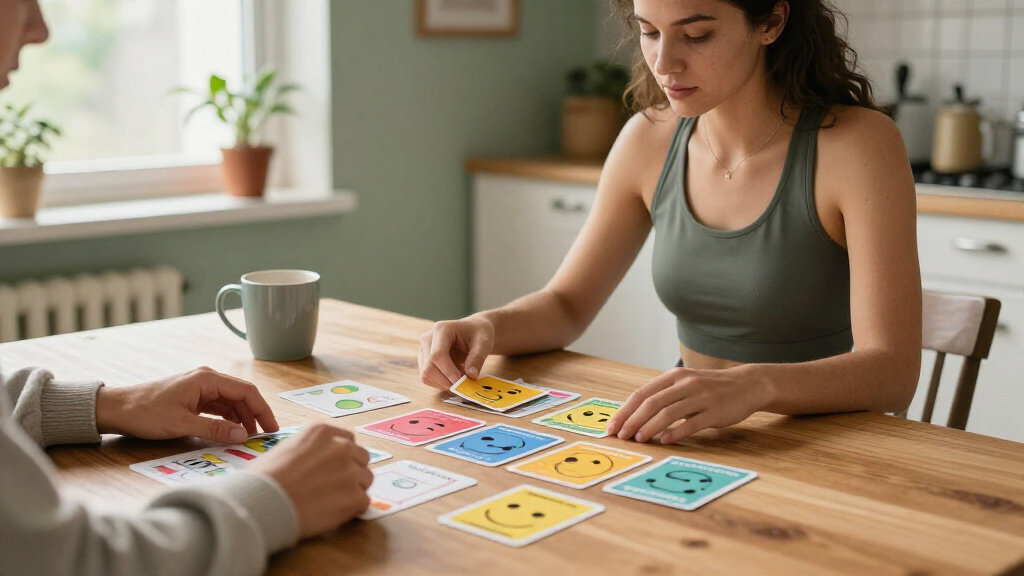
I compared these decks by how directly their stated content supports adult emotion regulation, how clearly a buyer can tell what to do with the cards, and whether the format fits solo or shared use. I also weighed the range of prompts or skills, the presence of a clear audience or practice framework, and practical details such as card count or included display stand when those details were supplied. A large deck is not automatically more useful: clear, relevant prompts can matter more than volume.
The order prioritizes direct usefulness for emotion-regulation practice, then distinguishes decks by breadth, audience fit, and activity style. That puts a focused DBT deck ahead of broad emotional-intelligence or mindfulness collections for buyers seeking explicit skills, while specialized, creative, and conversation-oriented options rank higher for their intended users. The product information provided does not establish clinical validation or outcomes, so I treat these as self-guided or discussion tools rather than therapy replacements.
| adult emotion regulation card game | Material |
|---|---|
| Coping Skills Cards for Anxiet | Waterproof PVC |
| Emotional Intelligence Mindset | — |
| Art Therapy Cards with 42 Guid | — |
| Mind Brain Emotion 52 Essentia | — |
| FeelWise Emotional Intelligenc | Cardstock |
| DBT Coping Skills Flash Cards | Cardstock |
| Neurodivergent Support Cards: | Cardstock |
| ARTAGIA Social Skills Therapy | Cardboard |
| 108 Mindfulness Cards for Copi | Paper |
Factors to Consider When Choosing Adult Emotion Regulation Card Games
Before choosing a deck, decide what you want the cards to help you do: identify a feeling, pick a coping response, reflect on a pattern, or open a conversation. These goals call for different kinds of prompts, and a mismatch can leave even a well-made deck unused.
Choose the kind of support you want
Some decks focus on naming emotions, while others prompt a coping action, a reflection, or a discussion. Decide whether you want a quick prompt for a difficult moment or material for a longer practice session. For in-the-moment use, short, direct instructions are often easier to act on than open-ended questions. Reflection decks can be more engaging when you have time and privacy, but may not tell you what to try next. A common mistake is buying a deck for its topic label without checking whether its actual activity matches your goal.
Match the structure to your comfort level
A defined framework can make it easier to practice a skill consistently, while a looser prompt deck gives you more room to interpret and adapt. If you are new to self-guided emotional skills, look for cards that explain an action clearly rather than relying on knowledge of therapy terminology. More experienced users may prefer prompts that invite personal reflection instead of repeating familiar instructions. Consider how much guidance you want on the card itself, since you may not have a booklet or facilitator nearby. The tradeoff is flexibility versus clarity, not simply beginner versus advanced.
Think through solo, group, and facilitated use
A deck intended for personal reflection may not naturally work as a group game, and conversation cards may ask for more disclosure than everyone wants to share. Before buying, picture where the cards will be used and who will be present. For a group, prompts should allow people to pass or answer at their own level of comfort. For solo use, consider whether the cards provide enough context to guide practice without another person’s help. Do not assume that a product described as a game will suit every social setting or emotional topic.
Check accessibility and audience fit
Prompt style, reading load, and sensory or communication preferences can affect whether a deck feels usable. A deck with a named audience may offer a closer fit for some people, but labels alone cannot guarantee that every card will feel relevant. Review the product’s described themes and activities, and think about whether the language is concrete, abstract, visual, or conversational. If using cards with another person, ask about preferred ways to respond rather than treating verbal answers as the only option. A well-matched format is more useful than a broad deck that asks you to adapt every prompt.
Prioritize usable content over card count
A larger deck can offer more variety, but quantity does not tell you whether the prompts are distinct, clear, or easy to revisit. Look for details about what the cards cover and how they differ from one another. A smaller set with focused activities may be easier to build into a routine, while a broad set can help when you want options across many moods or situations. Also check what physical accessories are included and whether they solve a real storage or display need. Choose depth or breadth based on how you plan to use the deck, not the biggest number on the package.
Set realistic expectations for self-guided tools
Emotion-regulation cards can offer prompts for practice and reflection, but they cannot diagnose a condition or replace individualized care. If a prompt brings up intense distress, you do not need to finish it or force a response. Some buyers may prefer to use a deck alongside a therapist or another trusted support person, especially when practicing unfamiliar skills. Check whether the activity feels manageable in your current setting, and set aside a prompt that does not fit. The best deck is a tool you can use safely and comfortably, not one that promises a particular outcome.
Frequently Asked Questions
Which type of deck makes the most sense if I want practical coping skills rather than reflection prompts?
Start with a deck that explicitly names coping skills or a skills framework, rather than one centered on drawing, conversation, or general emotional insight. In this lineup, the DBT and Mind Brain Emotion decks are the clearest directions to investigate for skill-focused content. Read the product details for examples of the actual exercises, since a title alone cannot show how much instruction each card provides. If you want to use a card during a stressful moment, favor prompts that are brief and actionable. A reflection deck can still complement skills practice, but it may not give you a next step on its own.
Are emotion regulation card decks appropriate for use with a therapist or support group?
They can serve as conversation starters or practice prompts, but the facilitator should decide whether a particular deck fits the group’s goals and comfort level. Conversation and reflection cards can invite personal disclosure, so participants should be able to pass or choose a less personal response. A structured coping-skills deck may be easier to connect to a planned exercise, while open-ended prompts allow more discussion. Check the card content before bringing it into a group, rather than relying on the product category. These decks should support, not direct, professional care.
How can I choose between a large deck and a more focused one?
Choose by the range of situations you want the deck to cover, not by card count alone. A larger collection may offer more options for identifying emotions and selecting techniques, but it can also take longer to browse. A focused deck may be easier to return to when you want one kind of practice, such as coping skills or guided drawing. Look for sample topics or a clear breakdown of card types before deciding. If you are unsure, the most useful choice is usually the deck whose prompts you can picture using repeatedly.
Can I use these cards on my own, or do I need another person?
Several formats in this roundup are naturally suited to solo reflection, such as mindfulness, coping-skill, and guided drawing prompts. A conversation game is more likely to need another participant, though you may still adapt some cards for individual reflection. Check whether the product explains what to do with a prompt, since unsupported questions can feel vague when used alone. For shared use, agree on privacy and the option to skip a card before starting. Pick based on your actual routine rather than assuming every deck works equally well in every setting.
Should I choose a deck made for a specific group, such as neurodivergent adults?
A stated audience can help narrow the search when the deck’s themes and language match your needs, as with the Neurodivergent Support Cards. Still, a label is not a guarantee that every prompt will feel suitable or accessible to every person in that group. Review the described activities and consider whether they fit your communication preferences and goals. If you are buying for someone else, ask what format they prefer rather than assuming the audience label settles the choice. A broadly framed deck may work better when its prompts are clearer or more relevant to the individual.
Conclusion
My best overall pick is DBT Coping Skills Flash Cards for buyers seeking a direct focus on emotional regulation and mindfulness practice. For best value in breadth, I’d look to FeelWise, whose mix of emotion and technique cards offers varied ways to engage, while recognizing that a larger set may take more sorting. Best for beginners depends on whether you want explicit skills or open-ended exploration: start with a clearly structured coping deck for guidance, or choose Art Therapy Cards if drawing feels like a more approachable entry point. For specific needs, Neurodivergent Support Cards target autism- and ADHD-related reflection, and ARTAGIA is the more conversation-oriented option. I can’t name a defensible best premium pick from the supplied product details, since they do not establish premium construction or added service; choose the deck with the clearest fit for your routine and preferred activity.
Fall Picks
fall essentials
As an affiliate, we earn on qualifying purchases.