
TL;DR

Turn your wind-down time into listening time
- Thousands of audiobooks, podcasts and originals
- Listen on your phone, tablet or Echo — also offline
- Cancel anytime
A UC Berkeley-led study found that older adults with more tau in the frontal cortex tended to have less coordinated slow waves during deep sleep and weaker overnight recall. The findings show an association, not proof that tau or the altered waves cause memory loss or predict Alzheimer’s disease.
Researchers at the University of California, Berkeley report that tau buildup in the brain’s frontal cortex is associated with less coordinated slow waves during deep sleep and weaker overnight memory in older adults. The study, published in Nature Neuroscience, links the sleep-wave changes to memory performance, but does not establish that they cause memory loss or diagnose Alzheimer’s disease.
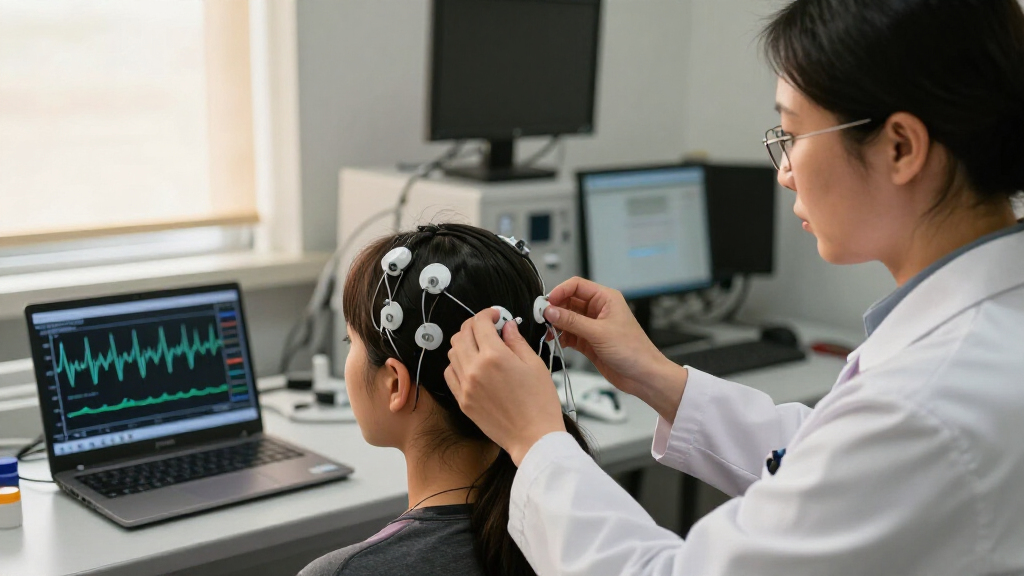
The team studied sleeping brain activity with electroencephalograms (EEGs), comparing cognitively healthy adults in their early 20s with older participants in their mid-60s to mid-70s. In younger participants, slow waves tended to travel together across broader areas. In older adults, the waves generally covered shorter distances and appeared more independently. Researchers referred to these more disconnected patterns as “lonely waves.”
For the older participants, the researchers also used PET scans to examine tau, a protein associated with Alzheimer’s disease. Greater tau accumulation in the frontal cortex was associated with a breakdown in the longer traveling waves seen during deep sleep. The reported tau-related changes occurred in people who had not developed Alzheimer’s and whose memory decline remained within the normal range for their age.
To test memory, participants learned pairs of associated words in the evening and were asked to recall them the next day. Those whose slow waves traveled shorter distances and appeared more isolated generally recalled fewer word associations. The study also tracked a subset of participants over several years, but the source report does not give detailed results from that follow-up.
How Sleep Waves Relate to Recall
The findings connect three observations in older adults: frontal tau accumulation, changes in deep-sleep brain-wave coordination, and poorer performance on an overnight memory test. That connection may help researchers investigate why recalling experiences becomes harder with age, and how sleep-related brain activity fits into changes associated with Alzheimer’s disease.
The work does not show that a person with isolated slow waves will develop Alzheimer’s, or that changing those waves would prevent memory decline. The participants with tau-related changes described in the report did not have Alzheimer’s, and their memory decline was within the expected range for their age. The results are therefore a research finding about associations, not a clinical test or a basis for predicting an individual’s future health.
Products Worth Considering

Withings Sleep Under-Mattress Sleep Tracking Pad

Withings BPM Connect Blood Pressure Monitor

OMRON Complete 2-in-1 Upper Arm Blood Pressure Monitor with EKG
As an affiliate, we earn on qualifying purchases.
Deep Sleep and Memory Consolidation
During non-REM deep sleep, large groups of neurons briefly become less active and then active again in coordinated patterns. These changes generate slow electrical waves that typically begin in the frontal cortex and can travel across the brain. The researchers investigated whether the waves’ coordination, and not simply their presence, was related to retaining recently learned information.
Omer Sharon, a postdoctoral researcher at UC Berkeley’s Center for Human Sleep Science, led the work with colleagues under the direction of former Berkeley sleep researcher Matthew Walker. The team worked with William Jagust, a UC Berkeley professor emeritus of public health and neuroscience, on the PET imaging. The study’s central contribution, as described in the report, is its link between frontal tau and the reduced travel of slow waves, alongside poorer recall.
“This is the first time we’ve shown this relationship between tau and how it messes with memory consolidation by attenuating traveling slow waves that originate in the frontal cortex.”
— Omer Sharon, postdoctoral researcher at UC Berkeley’s Center for Human Sleep Science
Limits of the Current Evidence
The reported results show associations; they do not establish whether tau disrupts slow waves, whether wave changes contribute to tau accumulation, or whether another process influences both. The word-pair task measured one kind of overnight recall, and the report does not provide enough detail to determine how well the findings apply to other forms of memory or to people with diagnosed Alzheimer’s disease.
The source report says a subset of participants was followed over several years and mentions changes in frontal tau, but its supplied text ends before presenting the follow-up results. The size and details of that subset, the magnitude of changes over time, and whether the wave patterns can predict later cognitive decline are not specified. The researchers’ findings do not establish a screening method or treatment.
Further Study of Tau and Sleep
The longer-term follow-up could help clarify how changes in frontal tau relate to sleep-wave patterns and memory over time, but the available report does not state what the researchers found or when further results will be published. Additional studies would be needed to test whether the association holds across larger and more varied groups and whether it predicts meaningful changes in everyday memory.
For now, the result is a research lead into how deep sleep and tau may relate to memory, rather than a confirmed explanation for an individual’s memory problems. The study does not report a clinical recommendation or an intervention based on the “lonely wave” pattern.
Key Questions
What are “lonely waves”?
They are the researchers’ term for slow brain waves during deep sleep that travel shorter distances and appear more independently instead of moving in coordinated groups.
Does the study show that lonely waves cause memory loss?
No. The study reports an association between shorter, more isolated waves and poorer recall on an overnight word-pair task. It does not establish that the wave changes cause memory loss.
Did the participants with tau have Alzheimer’s disease?
According to researcher Omer Sharon, the participants described as having tau-related changes did not have Alzheimer’s. Their memory decline was within the normal range for their age.
How did the researchers measure memory?
Participants learned associated word pairs in the evening and were asked to recall them the following day. Those with shorter, more isolated slow waves generally recalled fewer pairs.
Can this finding predict who will develop Alzheimer’s?
The report does not establish that the sleep-wave pattern can predict Alzheimer’s or diagnose the disease. Further research would be needed to assess its clinical relevance.
Source: sciencedaily.com