TL;DR

Turn your wind-down time into listening time
- Thousands of audiobooks, podcasts and originals
- Listen on your phone, tablet or Echo — also offline
- Cancel anytime
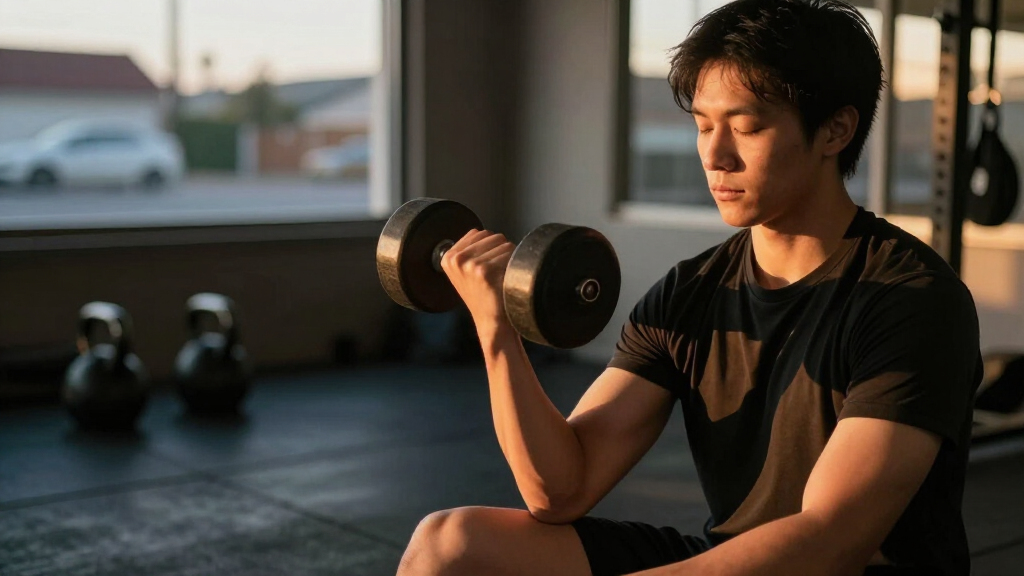
A Nautilus report describes research in which people who imagined exercising a small finger muscle increased its strength by 22 percent; participants who physically exercised it increased strength by 30 percent. The findings suggest motor imagery can support strength and skill practice, but do not show that imagining exercise can replace physical training.
A Nautilus report on motor-imagery research says that imagining exercise can increase muscle strength, citing an experiment in which people who mentally practiced activating a finger muscle gained 22 percent in strength. Those who exercised the muscle physically gained 30 percent, indicating that mental practice may help but is not a substitute for movement.
The finding comes from exercise scientist Guang Yue, whose research, as summarized in the Nautilus report, compared imagined exercise with actual exercise. Participants who imagined working the muscles that move the pinkie finger increased their strength by 22 percent. The group that physically exercised those muscles improved by 30 percent. The report does not provide the study’s sample size, duration, or full methods, so the figures should be read within that limited description.
The mechanism discussed is motor imagery: mentally rehearsing a movement without carrying it out. The report says imagined movement activates many of the same brain areas involved in real movement, while signals from other parts of the brain prevent the imagined command from reaching the muscles in the same way. It also notes that imagining exercise can raise heart and breathing rates, though it does not present those changes as equivalent to the effects of a workout.
The article links motor imagery to other forms of practice. It cites a golf experiment by Rutgers psychologist Robert Woolfolk and colleagues, in which people who imagined sinking a putt made 30.4 percent more successful putts than those who did not. It also describes research in which doctors who mentally rehearsed before virtual-reality surgery performed better than those who did not. These examples concern task performance and learning, not proof that mental rehearsal can replace physical conditioning.
Where Mental Rehearsal Can Help
The finding matters because it suggests that the brain’s role in movement can be practiced even when a person is not physically moving. For some people, mental rehearsal could be a useful addition to training: athletes can visualize a skill, and people learning a movement can rehearse its sequence. The reported finger-strength result also suggests that motor imagery may affect more than confidence or technique alone.
The size of the reported difference provides an important limit. The imagined-exercise group’s 22 percent gain was below the 30 percent gain reported for physical exercise. The Nautilus report does not establish that the percentages would apply to larger muscle groups, longer training programs, or different populations. Nor does it show that imagining movement produces the cardiovascular, mobility, or broader health effects of physical activity.
For readers unable to perform a movement in the moment, mental practice may be worth discussing as a complement to other training or rehabilitation approaches. The report, however, does not provide clinical guidance or establish a treatment effect for any health condition. Its central practical message is narrower: mental rehearsal may support practice, while physical training remains the stronger method in the comparison described.
Products Worth Considering

Therabody Theragun Relief Massage Gun, 3-Speed, Black

OMRON Complete 2-in-1 Upper Arm Blood Pressure Monitor with EKG

Hyperice Normatec Elite Wireless Compression Boots Recovery – Standard Size
As an affiliate, we earn on qualifying purchases.
How Imagined Movement Works
The report situates motor imagery within proprioception, the sense of where the body’s parts are. Imagining a movement is related to, but distinct from, seeing it in the mind. A person can mentally rehearse moving a limb without necessarily forming a visual picture of that action.
Scientists have considered the relationship between imagery and bodily response for more than a century. Nautilus traces an early proposal to Alexander Bain’s 1855 treatise, followed by Edmund Jacobson’s 1931 work on mental imagery and subtle muscle movements. More recent brain-imaging research, as summarized in the report, has found overlap between the brain activity involved in imagined and actual movement, alongside inhibitory signals that keep imagined actions from being carried out in full.
A paper in Frontiers in Human Neuroscience, published in June of the year referenced by the original article, was quoted as saying there is “compelling evidence that motor imagery promotes motor learning.” The supplied material does not identify that paper’s authors or year, and it gives no direct link between its broader review of motor learning and the specific finger-strength experiment.
Limits of the Strength Evidence
The supplied report does not give the finger-strength study’s full citation, participant count, training schedule, or details on how strength was measured. It is therefore not possible from this material alone to judge how broadly the 22 percent result applies or how long the gain lasted. The comparison with a 30 percent increase from physical exercise is reported, but the article does not provide enough methodological detail to assess differences between the groups.
The report also does not establish which people may benefit most, whether imagined training works for larger muscles, or whether the results hold across different ages and health conditions. It describes 20 minutes as an optimal mental-practice session based on a meta-analysis of multiple activities, but says the explanation is unclear; possible reasons include limited real-world feedback and difficulty maintaining concentration. These points remain suggestions, not settled explanations.
Pair Rehearsal With Physical Practice
The report’s practical conclusion is that mental practice should be treated as a supplement to physical practice. It does not describe a new trial or a forthcoming study, so no next research milestone is specified in the supplied material. Further details from the original finger-strength study would be needed to assess its design and the durability of the gains.
For now, the evidence described supports using motor imagery as one tool for rehearsing movements and skills, while keeping claims about strength gains tied to the specific experiment. The article says imagined practice may work best for tasks with a strong mental component and that it cannot replace the feedback and physical work of actually performing an activity.
Key Questions
Can imagining exercise make muscles stronger?
The Nautilus report describes a study in which people who imagined exercising their pinkie-related muscles gained 22 percent in strength. The material does not establish that the same result applies to other muscles or to everyone.
Does mental practice work as well as physical exercise?
Not in the comparison reported: imagined exercise was associated with a 22 percent strength gain, while physical exercise was associated with a 30 percent gain. The report presents mental practice as a supplement, not a replacement.
How long should a mental-practice session last?
The article says a meta-analysis of multiple physical activities identified 20 minutes as the optimal session length. It also says the reason is unclear, and the finding should not be treated as a universal prescription.
Why might imagining a movement affect the body?
Motor imagery uses many of the same brain areas involved in real movement, according to the report. In imagined movement, other brain signals inhibit the motor command from fully reaching the muscles.
Can mental rehearsal replace a workout?
No. The report says mental practice is a complement to physical practice. It does not show that imagining exercise provides the same strength gains or broader effects as actually moving.
Source: nautil.us